

Jhaptal

contribute
Support the Sacred Pulse
If you haven’t watched the Jhaptal preview yet, do so here. Scroll down to see donation options and other ways to contribute.
Whether through generous donations, joyful sharing with your circles, kind creative introductions, or valuably contributing your unique skills, your support can help this movie amplify the appreciation of Indian Classical Music and the sacred melodies and rhythms it carries in the world today.
Let’s complete this documentary together!
Ways to Contribute to this INDEPENDENT film
Donate : every gift brings this film closer to the finish line with one-time or monthly contribution options available below.
Spread the Word : share the preview with friends, musicians, yogis, artists, educators, and music lovers. Word of mouth is powerful.
Make Introductions : introduce the project to a producer, musician, editor, or festival contact who can help the documentary come to fruition and travel.
Host a Podcast Interview or Filmmaker Guest Appearance: offer virtual or in-person conversations with your community to create engagement and buzz for the documentary.
Contribute In-Kind Support : offer to help with editing, color, sound mix, festival strategy, or translations.
Stay in the Loop : sign up for the Aquamarine Yoga newsletter to receive occasional updates on the doc progress and sneak peeks.

Donate Today
Letter from the Filmmaker
A New Form for JHAPTAL
Namaskara, Namaste,
I first encountered Indian classical music through yoga practice, by wanting to learn more about the instruments involved in our kīrtans (devotional singing) and yogic chanting. I had recently graduated from NYU’s Tisch School of the Arts, one of the premier performing arts schools in the United States. Yet I never encountered the music there.
I wondered: how was it possible that I had just completed four years of formal artistic education in New York City without any introduction to the incredible artists, instruments, and ideas (can we at least mention the Nāṭya Śāstra, the ancient treatise on the performing arts) of Indian classical music and dance that I later only found a gateway into through my little yoga shala on Broadway?
My introduction to Indian classical arts thus did not come through a formal educational curriculum, even though I attended an expensive performing arts school. My introduction to the performing arts of India came directly through its artists in New York City’s Indian diaspora, from independent creative circles alive with rāga (melody) and tāla (rhythm), tabla, sitar, harmonium, sarod, vocal… and dancers of Kathak, Bharatanatyam, Odissi… as well as independent filmmakers from India and the diaspora.
At the fringes of New York’s music scene, and at the outskirts of its formal performing arts education, but at the living center of a vibrant cultural community flow, I discovered an extraordinary universe of music, movement, improvisation, rhythm, devotion and embodied knowledge… and Jhaptal was born in this sangam, this confluence.
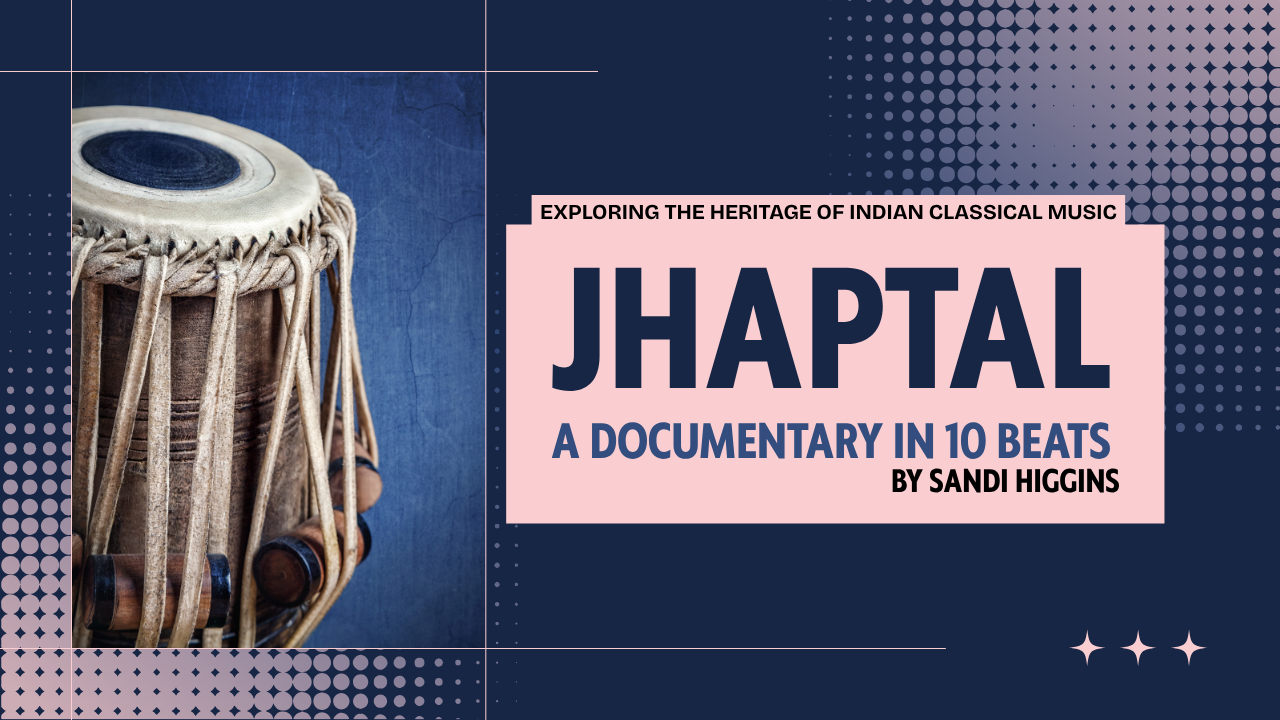
I began filming the Jhaptal project in 2007 just like a kind a video journal, using my camera to “take notes” at concerts and classes, guided by awe and curiosity for a music that was feeling like a perpetual revelation. I had started studying tabla, and was magnetized to learn as much as I could, but also had questions about the tradition of learning that came with it, the guru shishya parampara. I travelled across continents, concert halls, and family homes. I was drawn towards the instruments, sounds and artistic principles that felt intuitively familiar, even as I was only beginning to understand their vocabulary.
By 2009, I had already recorded an extraordinary video archive of more than 100 interviews with Indian classical musicians and musical collaborators, on stage, off stage, back stage. Performances, lessons, rehearsals and candid moments filmed across India, the UK, and the USA.
But my plans for the documentary project were interrupted.
Personal trauma eventually brought the project to a halt, and I stepped away from filmmaking altogether! I also stepped away from the music for several years. This is a story in and of itself.
Yet that interruption also redirected my life toward a depth of healing and transformation I could not have imagined, one that would more deeply inform my return. Navigating post-traumatic patterns of fight, flight, freeze and fawning, I found yoga. Yoga helped my nervous system discover another way of being. It turned the page.
Over the next decade, I devoted myself fully to Yoga. Through practice, study, teaching and life in India, I acquired a vocabulary the younger filmmaker who recorded the original material did not yet possess. Yoga gave me a clearer lens through which to see and hear my own archive of interviews—and to recognize what the musicians had been showing me all along about the cultivation of citta (the inner field of attention, perception, memory, imagination and awareness).
Returning to the archive now, I can bring the music into a fuller conversation with nāda yoga (the yoga of sound), not as a theory imposed upon it, but as a way of seeing sound, vibration, attention, devotion and transformation.
I began to understand riyāz (devoted daily practice) in conversation with abhyāsa (sustained practice over a long period of time), each becoming a form of sādhana (spiritual practice). I found dhāraṇā (focused concentration) in the gathering of attention around the music, dhyāna (uninterrupted meditative attention) in its continuous flow through performance, and Īśvara-praṇidhāna (surrender to the Divine) in those moments when disciplined technique moves beyond effort and becomes devotion, surrender and offering.
The extraordinary capacities cultivated by master musicians—their listening, memory, rhythm, intuition and spontaneous responsiveness—opened new questions about saṃyama (the integrated practice of concentration, meditation and absorption) and vibhūti (the extraordinary capacities that may arise through refined attention).
Indian classical music and Yoga are distinct traditions, but both ask what becomes possible when citta is trained, steadied and transformed through lifelong practice.
Years of Yoga have now led me back to filmmaking and back to the Jhaptal project with deeper understanding, a clearer vocabulary and a new set of questions through which to approach the archive.
Rather than forcing more than twenty years of footage immediately into a single feature film, I would now like to Jhaptal first as a series of focused documentary episodes.
Each episode can bring different voices, generations and artistic lineages into conversation around a central inquiry: riyāz, rhythm, rāga, attention, improvisation, devotion, the guru–śiṣya paramparā (teacher–student lineage), cultural change and the future of Indian classical music.
The episodic form gives the musicians and their ideas room to breathe. It allows rare archival conversations to enter into dialogue with the present, creates space for select follow-up filming and enables us to begin sharing this work while the larger form of Jhaptal continues to reveal itself.
These episodes are not a retreat from the larger vision. They are a way to begin realizing it, one coherent, producible story at a time, and may ultimately form the foundation for a feature-length film.
But I still need help to create them.
Jhaptal has been a self-funded, independent project from the beginning. Support now will help preserve and organize the archive, develop and produce the first episodes, film select new conversations and fund editing, translation, subtitles, research, rights and clearances, sound design, color finishing and distribution.
I am seeking producing partners, editors, researchers, translators, post-production collaborators, cultural institutions, patrons and funders who recognize the value of this material and want to help it reach an audience.
Jhaptal is both a cultural record and a living inquiry. It preserves rare voices, artistic lineages and embodied knowledge while asking how these traditions continue to move, adapt and awaken us now.
If you believe this archive matters, let’s create the first Jhaptal episodes together.
Contribute. Collaborate. Make an introduction. Share.
Every act of support helps bring this long-held vision to the screen.
Thank you,
Sandi Higgins
Filmmaker & Yoga Teacher
Watch a Sample
Preview 1

“It seems that nature helps to complete the music,
and both work together, for they are one.”
— Hazrat Inayat Khan, The Harmony of Life