

Namma Street Cow and the Soul of A City
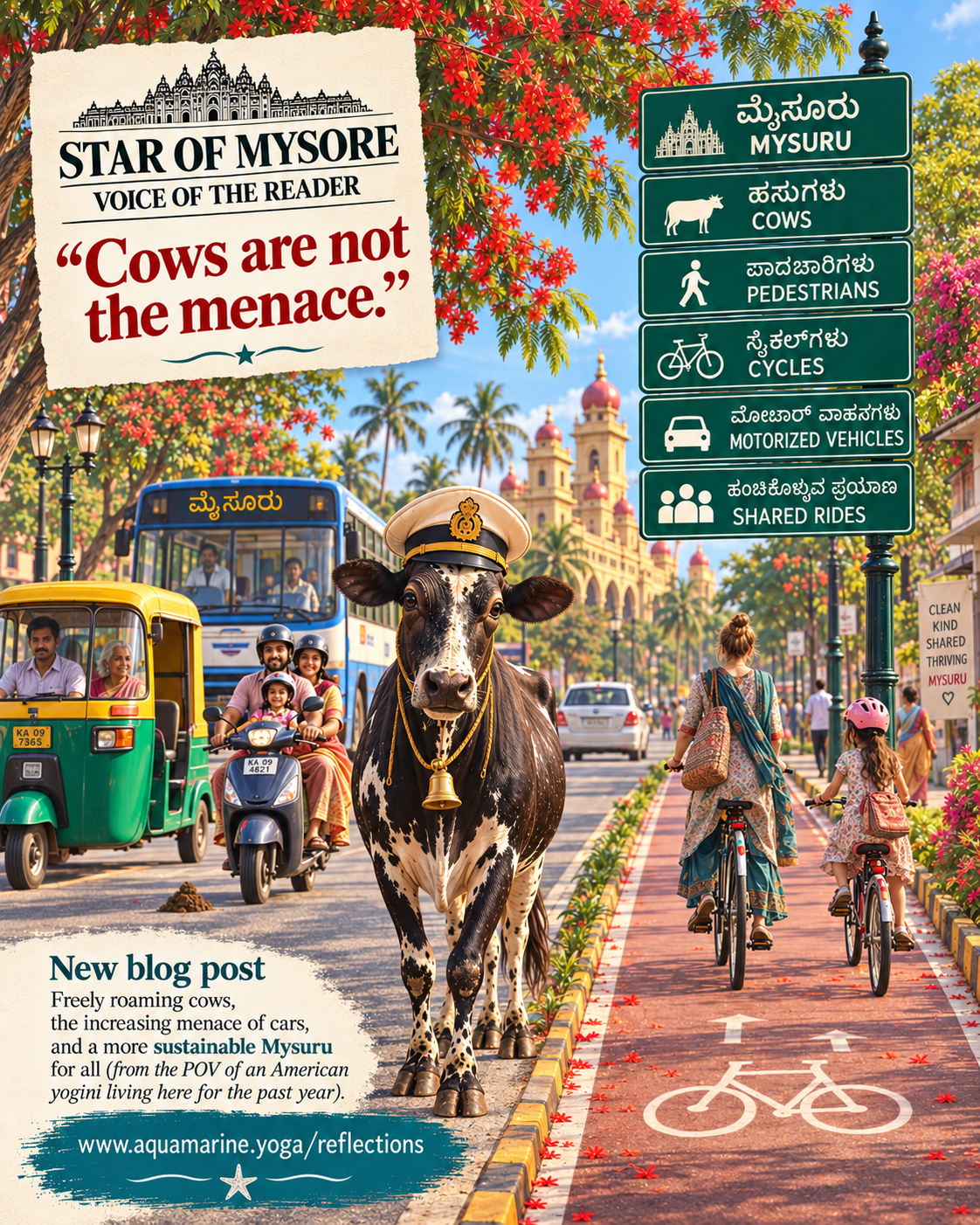
Holy Cows, Car Culture, and a More Sustainable Mysuru for All!
Last month, I read a Voice of the Reader letter in the Star of Mysore titled “Curb cattle menace on busy M.G. Road.” The writer describes the “recurring menace of stray cattle,” warns of the danger to motorists and pedestrians, particularly two-wheeler riders, and expresses frustration that cattle “continue to roam freely” on a busy Mysuru road.
A menace?
The word genuinely upset me. And I’m still thinking about it, so I’ve decided to write about it. It wasn’t just the one word, but its repetition. Again and again, the cows are framed as the problem.
Of course, I understand safety concerns. An animal unexpectedly crossing a busy road can contribute to an accident. I don’t want anyone, human or cow, to be hurt. We are both animals trying to navigate an increasingly busy shared environment.
There are legitimate questions about responsible animal care and about how humans and cattle can safely share increasingly busy roads.
However, I question the framing.
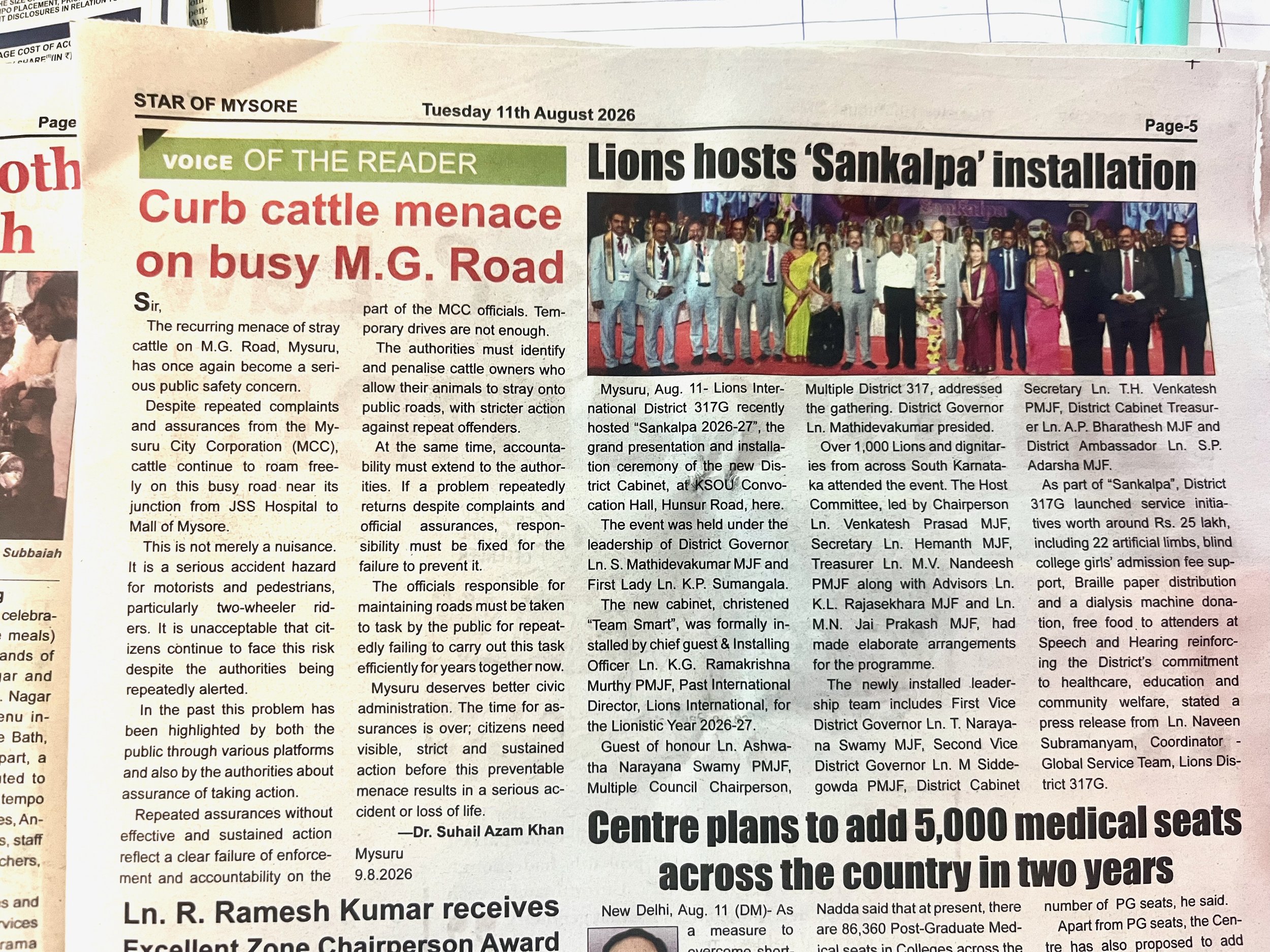
When a road becomes dangerous, why is the freely roaming animal called the “menace,” rather than the speed, density and design of the motor traffic surrounding them?
And that other phrase in the letter struck me too: cattle “continue to roam freely.”
Perhaps I see Mysuru’s street cattle differently precisely because I did not grow up with them. To my American-born eyes, there is something precious and extraordinary about sharing a modern city with so many animals that still can roam freely. The cows in particular.
I have been living and working in Mysuru for the past year, and visiting this city to study yoga for over a decade. I come from a country where the automobile has been allowed to reshape enormous portions of the landscape around itself.
Highways cut through communities. Trees and green spaces disappear beneath vast parking lots of asphalt.
We move hurriedly from private homes into private cars into private destinations, disconnected from the natural life, communal connection, and spontaneity between.
A society revolving around individuals armored inside their cars can become a violent and lonely one.
The cost is everywhere: hotter cities, fewer trees, less public space and familiar human interaction, more pollution, more isolation, and acres upon acres of living Earth suffocating beneath asphalt just to move and store cars.
Somehow it seems my country of birth, the USA, has convincingly advertised this vision of modern life to the world.
Which is precisely why I don’t take Mysuru’s street cattle for granted.
I recognize something worth protecting. Something people don’t have in the USA.
The cattle wander softly through neighborhoods. They stroll door to door, to homes, businesses and temples, like mendicants patiently begging for alms. They gratefully accept our food scraps, turning what might otherwise become waste into nourishment and, eventually, manure that returns nutrients to the soil.
They rest quietly beneath the trees, reminding us to rest too. They cross busy roads, and traffic moves around them.
Their peace in our midst is a blessing.
These animals are not speeding. They are not overtaking recklessly. They are not texting while driving. They are not burning petrol and diesel like there’s no end in sight.
Humans are the ones who make roads dangerous for everybody. The cattle make everybody on the road slow down.
When I see a cow standing peacefully in the middle of a Mysuru road, I experience exactly the opposite of a menace.
As Mysuru undergoes so much road development, perhaps we should ask what the real menace to our streets might be. Roads with more cars? Smoother roads for faster driving? Flyovers?
Is Mysuru becoming like traffic-dominated Bengaluru?
Bengaluru now has around 12 million registered motor vehicles for approximately 13 million people. In just one year, another 790,000 vehicles were added, more than 2,100 every day.
This is not simply a traffic problem. It is a question about what kind of cities we are building. What kind of culture are we creating and condoning?
There is a spirit in India that I have always admired: how many people can we fit on this one scooter so we can all get there together?
Increasingly, it seems the spirit is shifting to: how large a five-seat SUV can one person drive alone?
These enormous SUVs parade like bulls in china shops through the streets, air-conditioned castles on wheels, carrying just one or two people yet taking up enough road space for multiple families. Windows sealed, the drivers barely see, hear or feel the life of the city around them. If anything, that feels like a menace to people’s safety.
How can such a car culture possibly be sustainable in a country of nearly 1.5 billion people?
India is already the world’s third-largest annual emitter of carbon dioxide, after China and the United States (Our World in Data / Global Carbon Budget).
That’s a fact that needs context: India’s emissions per person remain far below those of many “developed” countries, and its historical contribution to global CO₂ emissions is also far smaller (Our World in Data).
This makes the development choices India makes now enormously important.
Road transport already accounts for about 12 percent of India’s energy-related CO₂ emissions and an estimated 20–30 percent of urban air pollution. Under current policy trajectories, India’s road-transport energy use and CO₂ emissions could roughly double by 2050 (International Energy Agency, *Transitioning India’s Road Transport Sector*).
Carbon does not recognize borders.
We share one atmosphere. Emissions produced on a road in Mysuru contribute to the same planetary warming affecting glaciers in the Himalayas, heat waves across India, droughts and floods elsewhere in Asia, and vulnerable communities around the world. More than 80 percent of Indians live in districts considered vulnerable to climate-induced disasters.
Replacing petrol cars with electric cars is not the whole answer. Cars require more than fuel. They require roads, parking, flyovers, metals, plastics, tyres, electricity and enormous amounts of urban land.
Roads widen.
Trees disappear.
Trees disappear!
Pedestrians become obstacles.
Animals become “menaces.”
Menaces!
Eventually, everyone needs a vehicle because the city itself has been redesigned around vehicles.
This is how the car takes over a city.
Bengaluru should be a warning to Mysuru, not a model to imitate.
And this is why I would like to offer some gratitude to one of Mysuru’s most under-appreciated urban planners:
The street cow.
Nature has installed her own traffic controllers.
Perhaps their occasional inconvenience is part of their gift.
Paris is investing more than €250 million in becoming more bicycle-friendly. London has invested billions in “Healthy Streets” designed to reduce road danger, lower speeds and make more room for walking and cycling. England has now committed £4.5 billion more to active travel.
Some of the world's most renowned cities are now spending enormous amounts of money trying to make cars slow down. Mysuru already has the cow.
With them, Mysuru also sustains something precious: a sense that human beings are not the only creatures entitled to occupy public space.
The cow does not care that you are late.
She does not care that you bought a fancy car.
She does not care that the road has been widened.
She stands there, chewing, or peeing, or pooping, or simply resting contentedly.
Basic animal behaviors that we can all relate to.
And in that moment, everyone around must accommodate this other living being.
The cow is a godsend to the street. She slows speeding vehicles, requires drivers to pay attention to the road, reminds humans to be humble in their animal nature… and does all this work for free.
And her presence is more profound than mere traffic control.
She is Gau Mātā. Mother Cow.
Let’s not forget that she is the source of most human’s milk and ghee and butter and yogurt etc. Her body nourishes so many human bodies. Her ghee feeds the sacred fires.
Her dung fertilizes the soil.
She gives and gives.
She is generosity embodied.
And we call her a menace?
Her ancient presence on our path recalls something modern streets are in danger of forgetting:
Not everything exists for human convenience.
Humans are not the center of the universe.
Other beings are here because they, too, belong here!
So no, I cannot think of the Mysuru street cow as a menace.
I adore her. She is a vision to behold.
I want to thank her and protect her.
When you see her in the road, please, brake with reverence.
The street cow is not in the way.
Slow down.
Look at her.
Thank her.
Even bow to her.
Our street cow is showing us the way to save our soul and the soul of our city.
Long live Mysuru! Long live street cows!
Love,
Sandi
(with a little help from AI)
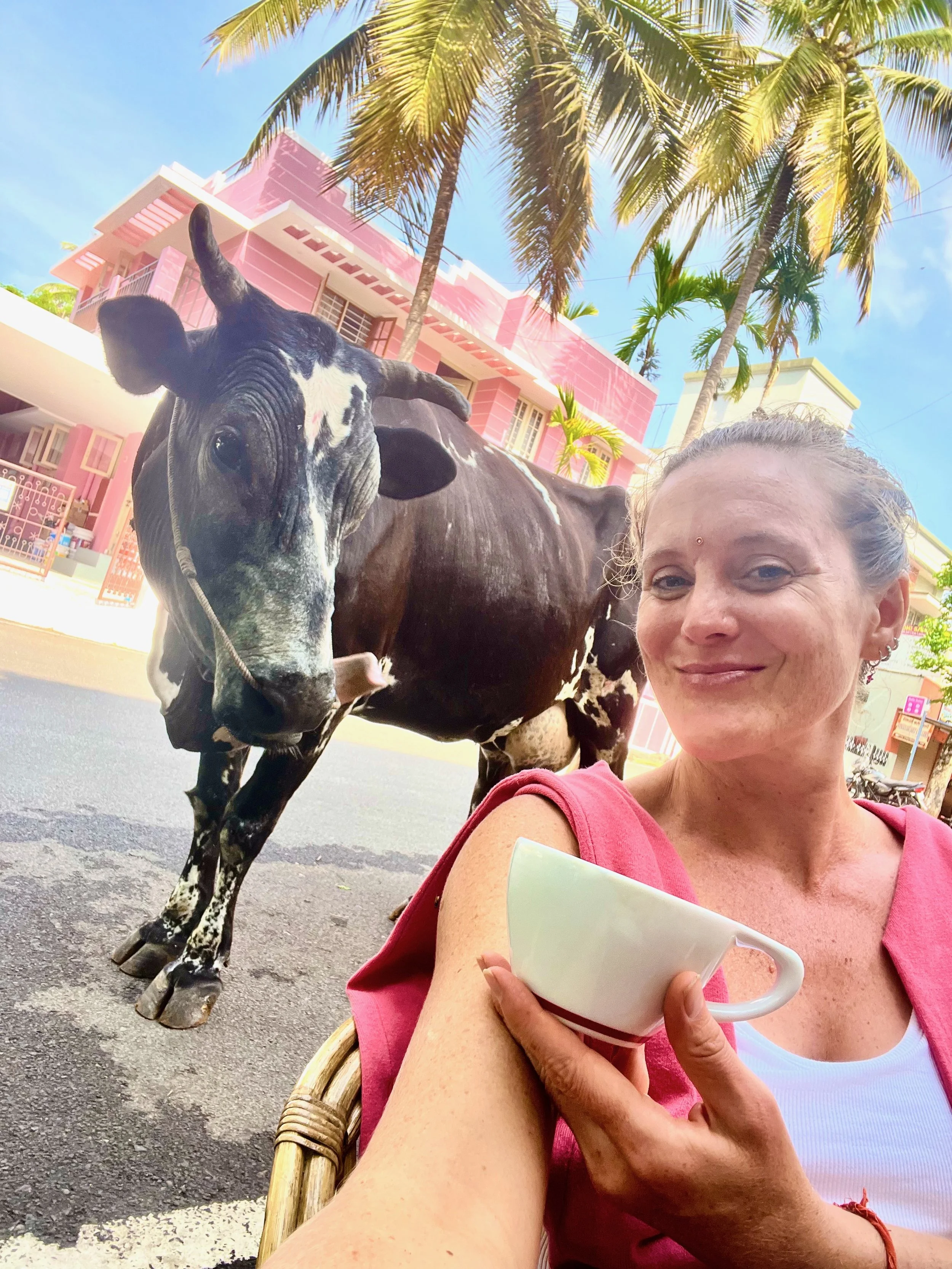
Namma Street Cow & Coffee in Gokulam, Mysuru (this is a real picture not AI generated)
