

Patañjali, Yoga & the Bhavachakra: why we practice
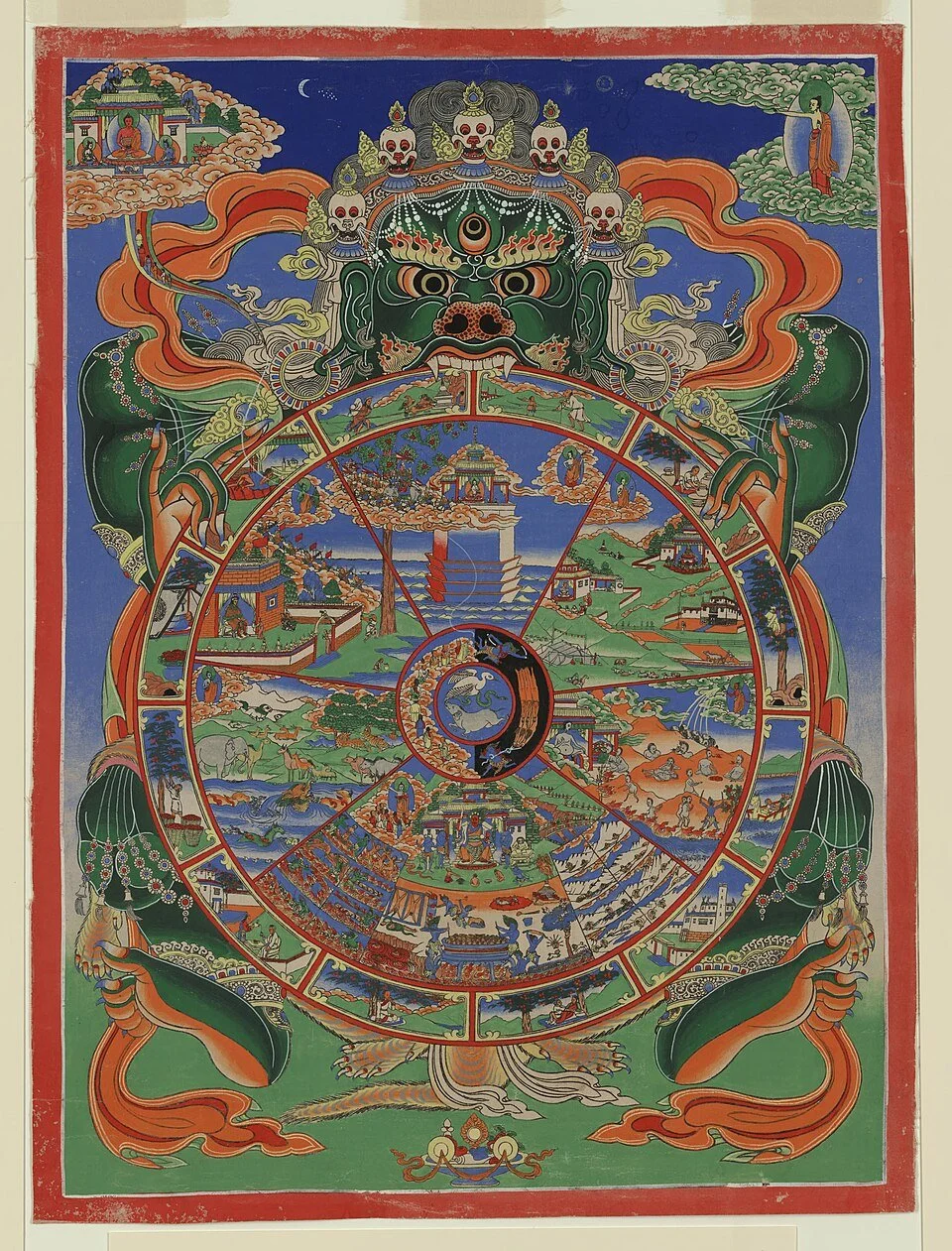
The Bhavacakra (Sanskrit: भवचक्र; Pali: bhavacakka), or Wheel of Becoming, is a symbolic representation of the cyclical realms of existence used popularly in Tibetan Buddhism. Courtesy: Wikipedia
In a recent session of our current Online Patañjali Yoga Sūtra Study Circle, a great question was raised:
If Patañjali tells us that the vṛttis (the fluctuating activity of our mind-field) can be either kliṣṭa (afflicted) or akliṣṭa (non-afflicted), why does Yoga seek nirodhaḥ (stilling or cessation) of all the vṛttis?
Why not just the afflicted ones?
Another way of asking this might be:
Why practice and study Yoga if we’re not currently suffering?
The question takes us right back to the opening verses of the Yoga Sūtras.
What does Patañjali say?
I.2
yogaś citta-vṛtti-nirodhaḥ
Yoga is the stilling or cessation of the fluctuations of the mind-field.I.3
tadā draṣṭuḥ svarūpe ’vasthānam
Then the Seer abides in its own nature.I.4
vṛtti-sārūpyam itaratra
Otherwise, there is identification with the fluctuations.I.5
vṛttayaḥ pañcatayyaḥ kliṣṭākliṣṭāḥ
The fluctuations are fivefold and may be afflicted or non-afflicted.
So why, then, if the fluctuations of the mind-field are not all afflicted, does Yoga ultimately point toward nirodha of them all?
The Bhavachakra: the Wheel of Becoming
To think about this question, I want to look at a beautiful map from another Indian contemplative tradition, the Buddhist Bhavacakra, literally the Wheel of Becoming (bhava), sometimes called the Wheel of Saṃsāra or the Wheel of Life.
The wheel is held by Yama, the Lord of Death, representing the inevitability of death and impermanence that frame conditioned existence.
We could spend all 10 weeks of our study circle discussing the Bhavacakra itself. But for now, suffice it to say that it depicts six realms of potential experience for sentient beings:
God Realm: pleasure, abundance, ease
Asura Realm: competition, jealousy, striving
Human Realm: a mixture of pleasure and suffering
Animal Realm: instinct, fear, ignorance
Hungry Ghost Realm: insatiable craving
Hell Realm: overwhelming suffering, anger, torment
These realms have rich cosmological meanings within Buddhist traditions, but we can also use them as a map of human psychology.
We might recognize ourselves in one of these realms in any given moment, day, periods of our lives, or, according to traditions of rebirth, lifetimes!
One moment, everything is wonderful. Namaste, God Realm.
The next, we are comparing ourselves with someone else, competing and striving. Welcome to the Asura Realm.
Then we want something desperately and cannot seem to feel satisfied when we get it. Hungry Ghost Realm.
Then suddenly we are suffering so intensely that it seems impossible to imagine anything beyond our pain. Hell Realm.
The wheel keeps turning.
Whether we understand these as literal realms of rebirth, psychological states, or both, the essential insight for our purposes is the same:
None of them stays.
The vṛttis belong to Prakṛti.
This brings us back to Patañjali (and to Sānkhya Philosophy - more on that available here).
The forces of activity within our mind-field, the vṛttis, belong to this phenomenon of Prakṛti, which Patañjali calls “the Seen.”
Everything within Prakṛti is subject to arising, transformation, and cessation.
Our thoughts change.
Our emotions change.
Our perceptions change.
Our memories change.
Our bodies change.
Our relationships change.
Our circumstances change.
Even our most beautiful states of mind change.
So even if you are having a “God Realm” experience with your vṛttis, no matter how wonderful it is, that experience remains part of the changing realm of Prakṛti.
The problem is not that the experience is pleasurable.
The problem is mistaking something impermanent for something that can provide permanent freedom.
A pleasant Fluctuation is not the same thing as liberation.
This helps us understand why Patañjali distinguishes between kliṣṭa and akliṣṭa vṛttis without defining Yoga simply as the elimination of the kliṣṭa ones.
Non-afflicted vṛttis can be enormously important.
Clear thinking can help us practice.
Discernment can help us recognize suffering.
Study can orient us toward liberation.
Meditation can cultivate greater clarity and steadiness.
A more sattvic mind may be far more conducive to Yoga than a mind dominated by agitation, confusion, or craving.
But even the most beautiful, clear, sattvic state remains a state.
It arises.
It changes.
It passes.
So the distinction is subtle but important:
An akliṣṭa vṛtti may help carry us toward liberation without itself being liberation.
Yoga is therefore not about securing “permanently pleasant” vṛttis, because nothing belonging to Prakṛti can be made permanently unchanging.
It is about changing our relationship to the fluctuations themselves.
Why practice Yoga when things are going well?
This brings us back to our original question.
Why practice Yoga if we are not suffering?
The Bhavacakra gives us a compelling answer.
Because the wheel turns.
When life is wonderful, we may easily believe that if we can just preserve our present circumstances, relationships, body, health, success, identity, or state of mind, everything will be okay.
But the very nature of conditioned existence is change.
This is also why the Human Realm is traditionally considered especially auspicious for spiritual practice.
Situated between the intense pleasures of the higher realms and the overwhelming suffering of the lower realms, human existence offers a particularly fertile balance.
There is enough suffering for us to recognize that something about conditioned existence cannot ultimately satisfy us.
But there is also enough ease, awareness, and agency for us to actually undertake a path toward freedom.
In overwhelming suffering, it may be extraordinarily difficult to practice.
In overwhelming pleasure, we may see no reason to practice.
The Human Realm sits somewhere in the middle.
And so we do not have to wait until our circumstances, or our vṛttis, are perfect before practicing.
Nor should we wait until they become unbearable.
Liberation is not “the best place” on the wheel.
Perhaps this is the most important point.
Liberation is not another realm in the Bhavacakra.
The goal is not to climb from the Hell Realm to the Hungry Ghost Realm to the Animal Realm to the Human Realm and eventually reach the God Realm, where everything finally stays wonderful forever.
The whole wheel is the wheel.
From the perspective of Patañjali (and Sānkhya Philosophy), all changing experience belongs to Prakṛti.
As long as we identify ourselves with the movements of citta, whether painful or pleasurable, we remain identified with something that changes.
Patañjali points instead toward Puruṣa, the draṣṭṛ, the Seer.
This is why immediately after defining Yoga as:
yogaś citta-vṛtti-nirodhaḥ
Patañjali tells us:
tadā draṣṭuḥ svarūpe ’vasthānam
Then the Seer abides in its own nature.
Liberation is therefore not about finding the perfect experience or realm and grasping at it.
Liberation from suffering is not another realm on the wheel.
Liberation is freedom from the wheel itself.
And that freedom is possible regardless of where we presently find ourselves within the changing conditions of experience.
Through nirodha, we cease to identify with the changing vrittis, and the Seer freely abides in its true nature.
If questions like these spark your curiosity, you can join the next cycle of the Online Patañjali Yoga Sūtra Study Circle where we journey into the yoga sūtras together through conversation, recitation, memorization, and open-minded reflection on the practical questions that emerge. The next 10-week cycle begins in October. Explore what Patañjali’s Yoga Sūtras mean for you!
Also related, this September, get a deeper understanding of Puruṣa and Prakṛti and the philosophical foundation of the yoga sūtras in the Online Weekend Workshop: INTRO TO SĀNKHYA PHILOSOPHY THE FOUNDATION OF YOGA WITH DR. KULDIP DHIMAN (September 4th & 5th)
